
Maharashtra has topped the list of states with the most favourable ecosystem for the growth of Farmer Producer Organisations (FPOs), replacing Madhya Pradesh, which has slipped to second place, according to the latest Ease of Doing Business for FPOs (EoDBF) ranking.

'Legally clean farmland is difficult to find. It requires time, money, and legal effort to verify the title.'

New lower GST rates kicked in from Monday, resulting in a slashing of prices of as many as 375 items ranging from toothpaste and shampoo to cars and television sets, a move seen as an attempt to boost consumption to cushion an economy facing tariff headwinds. Tax rates of 5, 12, 18, and 28 per cent have been clubbed into two rates of 5 per cent and 18 per cent, resulting in a reduced price of 99 per cent of daily use items.
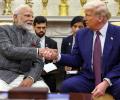
'India's farmers will be unable to compete with the US, given the subsidies that the latter provides its farmers.'
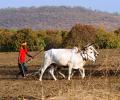
Farmer representatives and agricultural stakeholders urged the government to provide cheaper long-term credit, implement lower taxes, and double the PM-KISAN income support during a comprehensive pre-budget consultation with Finance Minister Nirmala Sitharaman on Saturday. The two-hour meeting saw a detailed discussion of proposals, aimed at addressing multiple challenges in the agricultural sector, with key demands focusing on financial relief, market reforms, and strategic investments.

The Supreme Court on Friday ordered immediate medical aid for farmer leader Jagjit Singh Dallewal, who is on an indefinite fast at the Punjab-Haryana border. The court also urged farmers to adopt the Gandhian way of protesting and to ensure that Dallewal's life is saved. The court has formed a high-powered committee to make recommendations to the stakeholders regarding the farmers' grievances.

'Just as we cannot surrender the interests of our farmers and dairy industry, Trump is also looking for markets for the produce of the farmers in the Midwest, which are his support base.'
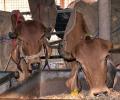
Cattle trade has been suspended in several weekly markets in Jalna district, Maharashtra, following allegations of harassment and attacks by cow vigilantes. Traders cite prolonged legal battles and selective targeting as reasons for the boycott.

'What the US appears to be doing is to force India to be "the buyer of last resort", on whom their products can be dumped, 1.4 billion people have to eat something, so why not eat American corn?' 'What is exercising the Trump lot is the fact that most of the farms are in solidly Republican Midwestern states: Illinois, Indiana, Kansas, Michigan, Minnesota, Missouri, Nebraska, North Dakota, Ohio, South Dakota, Wisconsin,' points out Rajeev Srinivasan.
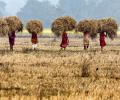
In a significant policy shift aimed at boosting agri-productivity and rural prosperity, Finance Minister Nirmala Sitharaman on Saturday announced six new agricultural schemes while increasing the subsidised Kisan Credit Card loan limit to Rs 5 lakh from the existing Rs 3 lakh, benefiting 7.7 crore farmers, fishermen, and dairy farmers.

Amid uncertainty over trade talks with the US, Prime Minister Modi asserts India's commitment to protecting the interests of farmers and fishermen, vowing no compromise on their behalf.

'This is not just about Modi saying it, every Indian should say this -- if we want India to become the third-largest economy, every political party and every leader, keeping aside their hesitations, must work in the nation's interest and awaken the spirit of Swadeshi among the people'

A group of onion traders gathered at the Pimpalgaon Agricultural Produce Market Committee (APMC), near Nashik, to inspect one of the season's final harvests of red onions as they look to place their bids. They were surrounded by farmers, who brought their produce here from different parts of the district. Farmers have reasons to be optimistic.

Four big global companies - Bayer, GenZero (a wholly-owned arm of financial major Temasek), Shell and Mitsubishi - have decided to scale up their carbon credit programme in nine states to empower farmers. The credits are generated through the adoption of smart agriculture practices - Alternate Wetting and Drying (AWD) and Direct Seeded Rice (DSR). Since over a year, the project, which was being run on a pilot basis, has positively impacted 10,000 farmers, covering more than 25,000 hectares.
'The government's priority is not farmers.'

'It was like rigorously preparing for a solid, good exam...' 'I don't know what marks I will get, but I felt the rigorous preparation of an exam.' 'You may sweat, but I feel rejuvenated.'

IMD data shows in the 24 hours between September 1 and 2, Haryana received 806 per cent more rainfall than normal, Punjab 759 per cent, Himachal Pradesh 510 per cent, Delhi 740 per cent, Chandigarh a staggering 1,638 per cent, and Rajasthan 193 per cent.
This would be due to early monsoon onset, abundant precipitation in the soil and the government's higher minimum support price (MSP) for farmers, the USDA said in its assessment.
The relations between New Delhi and Washington are on a downturn after Trump doubled tariffs on Indian goods to a whopping 50 per cent, including 25 per cent additional duties for India's purchase of Russian crude oil.

RBI's interest rate decision, quarterly earnings and global cues would be the major driving factors for equity markets this week, analysts said adding that the impact of the Union Budget could linger on this week. Trading activity of foreign investors will also be a key driver for the markets, experts noted. "US and India's manufacturing PMI for January to be released on Monday, will be the key macro data to watch out for.

While naming him as the NDA candidate for the Vice President's post, the BJP had described him as 'Kisan putra', a move seen in the political circles aimed at reaching out to the politically significant Jat community which had participated in huge numbers in the year-long farmers' protests against agriculture reform measures unveiled in June 2020.

'Till a few years ago, girls wouldn't take an autorickshaw alone. Now, things have improved.'
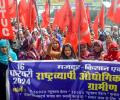
Over 25 crore workers across India are set to strike against new labour codes and privatisation, potentially disrupting banking, postal, and other essential services.
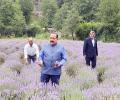
From using lavender in traditional Dogri embroidery to making essential oils, beauty products and food syrups infused with this flowering plant, Bhaderwah, once known for its maize fields, is embracing lavender to bring about an economic transformation to their small town.
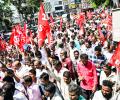
A nationwide strike called by trade unions to protest against the central government's labor policies had a mixed impact across India. While normal life remained largely unaffected in most parts of the country, some sectors like banking, transport, and insurance experienced disruptions. Sporadic incidents of violence were reported in West Bengal.
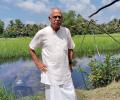
'Everything about farming is enjoyable and relaxing.'

Experts say the state's economy is grappling with hidden debt, rising welfare costs, and lack of transparency.

Trump's tariffs, falling shrimp prices, and fears of additional US levies, spark a crisis in Andhra Pradesh's politically vital aquaculture sector.
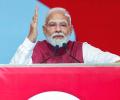
Prime Minister Narendra Modi asserted that his "vocal for local" campaign is bearing fruit as Indian products are going global and making their presence felt across the world. He said that India was becoming the land of infinite innovations, finding affordable solutions and offering them to the world. The prime minister also highlighted the country's rising defense products, electronics, automobile sector, and the success of superfoods, Ayush products, and yoga. He said India should be presented to the world as it is, without any bias. Modi said that the country was now emerging as a manufacturing hub and a "factory of the world." He added that India was creating solutions that were affordable, accessible, and adaptable, and offering them to the world without gatekeeping.
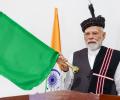
In the last 11 years, India and the world witnessed what he stood for, what he promised and did not deliver, and what he actually stood for and practised without fearing how history would judge him. Modi's tenure has been punctuated with headline-grabbing decisions, symbolic gestures, and stage-managed moments that continue to define his leadership and India's politics, points out Ramesh Menon.

Some of the key names include: Maruti, M&M, Ashok Leyland, Britannia, Ultratech, JK Cement, Havells, Voltas, Amber, Metro, Trent, LemonTree, Indian Hotels, Niva Bupa, HDFC Life, IGL, Acme Solar, Suzlon, Swiggy, Delhivery, ICICI Bank, HDFC Bank, Bajaj Finance, Shriram Finance," according to a report by Motilal Oswal Financial Services.
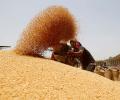
The government on Wednesday increased the Minimum Support Price (MSP) for wheat by Rs 150 to Rs 2,425 per quintal for the 2025-26 marketing season, a move that comes ahead of key state elections. The Cabinet Committee on Economic Affairs (CCEA), chaired by Prime Minister Narendra Modi, approved price hikes for six rabi crops, with increases ranging from Rs 130 to Rs 300 per quintal for the 2025-26 marketing season beginning April 2025. "Like for kharif crops, there is a significant increase in the MSP for rabi crops," Information and Broadcasting Minister Ashwini Vaishnaw said in a media briefing after the Cabinet meeting.

"India is not only buying massive amounts of Russian Oil, they are then, for much of the Oil purchased, selling it on the Open Market for big profits," Trump said in a social media post on Monday.

The point to note for India is that we must not panic. The United States may be our largest export destination, but high tariffs will not exactly mean gloom and doom. Sure, we can throw some morsels as we continue negotiating, but we must be firm that some red lines cannot be crossed, no matter what, asserts Shreekant Sambrani.
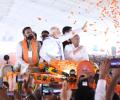
'People are fed up with rising crimes and poor law and order.' 'Modi must have got feedback and decided not to touch the 'jungle raj' issue as it will backfire.'
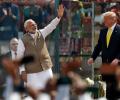
'It's important for India to think about areas where it wants the US to move.' 'We can be far more innovative in what we ask the US.' 'Given that there's a package deal, why not do it?'

India would neither succumb to the Americans on issues of national security, such as its defence ties with Russia, nor cede ground on its domestic interests in the agriculture and dairy sectors.
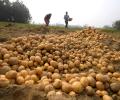
Amid the political blame game over Bengal's potato ban, which led to shortages in Jharkhand and Odisha, Uttar Pradesh farmers are the unlikely winners.

The Indian government has assured citizens that the country has ample food stocks to meet domestic demand, despite escalating tensions with Pakistan. The government has also warned traders against hoarding essential food items and creating artificial shortages, emphasizing that there is no need for panic buying. The food ministry detailed the country's current stock levels, showcasing a surplus over required buffer norms for rice, wheat, and pulses. Additionally, India holds substantial edible oil and sugar stocks, ensuring a strong food security position.

Recent documents by NITI Aayog and periodic labour force surveys on employment show that the importance of agriculture is rising in the Indian economy.
 © 2026 Rediff.com - Advertise with us - Disclaimer - Privacy Policy - Sitemap - Feedback - About us - Terms of use - Grievances